Web Development for St. George Businesses: A Local Website Checklist That Builds Trust
A practical St. George web development checklist for building a clear, useful local business website that helps customers act and helps search engines understand your services.
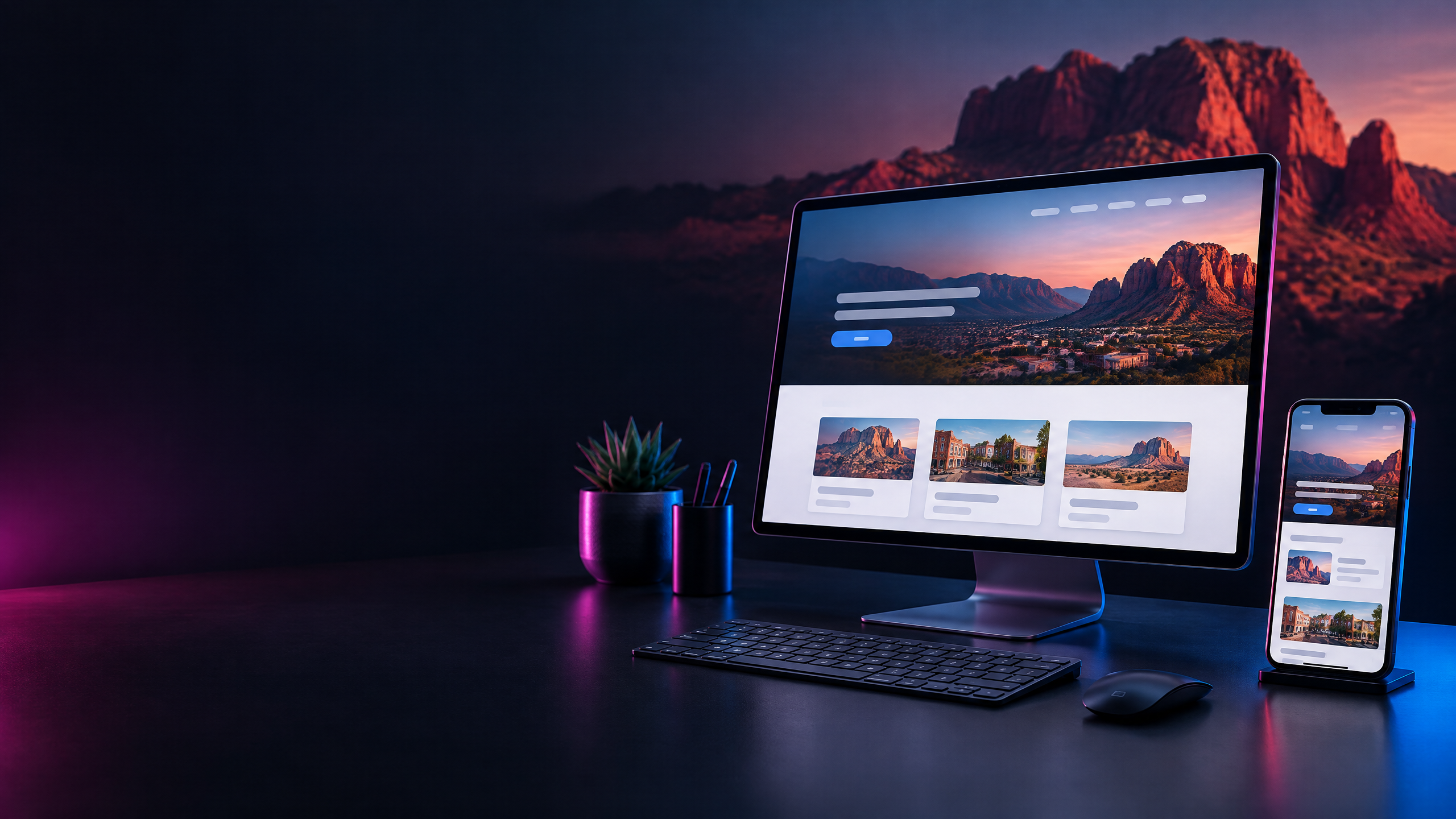
A St. George business website should make one thing easy: a nearby customer should quickly understand what you do, who you help, where you work, and how to contact you. If that answer is buried under stock phrases, a beautiful homepage will not carry the whole job.
Good web development is not a race to add more pages, plugins, or search phrases. It is the work of organizing real business information into a fast, useful path for people. That same clarity also gives Google and emerging AI search experiences better material to understand.
What should a St. George business website include?
Start with the questions a potential customer is trying to answer on a phone between errands, at work, or after a recommendation from a neighbor. What service do you provide? Which communities do you serve? What makes the next step simple? A useful homepage can answer those questions without making visitors hunt through a carousel, a menu with seven levels, or a wall of clever but vague copy.
For a Southern Utah service business, that usually means a plain-language service statement near the top, clear service links, a real phone number or booking path, and location details that match how you actually operate. If you serve St. George, Washington, Ivins, Santa Clara, Hurricane, or a larger regional area, say so accurately. Do not create a separate thin page for every nearby town just to repeat the same paragraph. Build pages that genuinely help the people you want to reach.
Build each service page around a customer decision
A service page should do more than announce that a service exists. It should help a visitor decide whether you are a fit. Explain the problem the service solves, what the process looks like, who it is for, and what someone should do next. A contractor may explain the types of work they take on and their service area. A med spa may explain a treatment in clear, responsible language. A restaurant may make menus, hours, ordering, and directions painless to find.
This is also where local marketing and web development meet. You can use the words customers use naturally, such as "video production in St. George" or "local SEO for Southern Utah businesses," but the phrase is only useful when the surrounding page gives a complete answer. Google recommends people-first content that is helpful and reliable, rather than material made mainly to manipulate rankings. Write for the customer who needs a decision, then make the page structure clear enough for search systems to follow.
Make mobile the real first draft
Most local visitors will encounter a website on a small screen, often from Maps, social media, a text message, or a direct search. Treat mobile as the real first draft, not the version that receives leftovers after desktop design. Buttons should be easy to tap, body copy should be comfortable to read, forms should ask only for what you need, and key information should not be hidden inside tiny tabs or hover-only effects.
A mobile-first site does not have to be bare. It needs hierarchy. Put the primary action where people can see it, such as call, request a quote, book a consultation, order, or get directions. Use photos and video that help visitors understand the work, location, product, or experience. Then test the actual path yourself on a phone: open the homepage, choose a service, and try to become a lead. If it feels slow or confusing to you, it will feel even more confusing to someone who has never heard of your business.
Keep your website and Google Business Profile consistent
Your website is not a substitute for a Google Business Profile, and a Business Profile is not a substitute for a useful website. They should tell the same true story. Google says local results are mainly based on relevance, distance, and popularity. A complete, accurate Business Profile can help Google understand what a business is and where it is located, while a well-built website gives customers deeper answers about services, proof, process, and next steps.
Review the practical details in both places: business name, phone number, address when applicable, service area, operating hours, primary category, and core services. Use the version that is accurate in the real world, not an exaggerated list designed to chase every possible search. When people land on your site from Maps, the page should reinforce the decision they were already starting to make, not send them back to Google for basic details.
Use structured data as supporting context, not a magic switch
Structured data is a standardized way to describe a page for search systems. For an eligible local business, LocalBusiness markup can communicate details such as a business name, address, hours, and other relevant information. It does not guarantee a ranking, a knowledge panel, or a rich result. It is supporting context that works best when it matches the visible information on a useful page.
If you add structured data, validate it before assuming it is working. Google recommends testing markup with the Rich Results Test and then using URL Inspection to see how Google views a deployed page. This is the unglamorous but important part of local web development: clean implementation, consistent facts, and regular checks beat adding a random block of code and hoping it changes everything overnight.
Give search and AI systems something specific to understand
AEO and GEO are often discussed as if they require a secret format. The practical foundation is less mysterious. Clear headings, honest service explanations, concise FAQs, accurate business details, helpful internal links, and real examples make it easier for people and systems to understand what your business does. A page that answers a real question is more useful than a page that repeats the same city and service phrase twenty times.
That does not mean every answer belongs on one giant page. Create a sensible site structure. Your homepage can introduce the business. Service pages can explain each offer. A portfolio can show selected work. Articles can answer questions customers ask before they are ready to call. For an EEM client, Web Design & Local SEO can bring that structure, local search fundamentals, and content planning together without turning your site into an agency template.
A practical next step
Put the advice to work locally.
Quick questions, answered.
Does a new website automatically improve local SEO?
No. A new website can provide a stronger foundation when it is clear, crawlable, useful on mobile, and consistent with the business information customers see elsewhere. Local visibility also depends on factors such as relevance, distance, prominence, and accurate Business Profile information.
Should every St. George business have a separate page for every nearby city?
Not automatically. Add a location page only when it has a distinct and useful purpose, such as a real office, a specific local service process, or unique information for that community. Repeating the same text with a swapped city name is not useful to visitors.
What is the most important page to improve first?
Start with the page that receives the most customer attention or represents the service you most want to sell. Make its offer, service area, proof, frequently asked questions, and next step clear before spreading effort across low-value pages.
Can Electric Edge Media help with both website development and local marketing?
Yes. Electric Edge Media builds websites and local search foundations alongside video production and social media marketing, so the customer journey can stay connected from discovery through inquiry.
Build a website that does its part in the local marketing system
Your website should not be a digital brochure that gets ignored after launch. It should be a clear home base for the questions, proof, services, and next steps that turn local attention into real conversations.
If your current site feels outdated, hard to use on mobile, or disconnected from your St. George marketing, Electric Edge Media can help you turn it into a more useful local growth tool.
Book a website conversation